
Review by David Neice
Advance Paris A5 Playstream Amplifier: A Swiss Army Knife
MSRP: Playstream A5 $1,875.00 Canadian (BT X-FTB01 receiver included)
Upgrade: X-FTB02 Bluetooth Receiver $200.00 (see footnote)
Verdict: The Advance Paris A5 Playstream amplifier has so many options as inputs and outputs that, for the money involved, it can only be described as a Swiss Army Knife of amplifiers. It is an astonishingly complete package for streaming music.
Where else can you find a modestly priced amplifier that has a complete list of multiple analog inputs and outputs (five line level inputs plus pre-out and sub out and amp in) and a complete set of digital ins and outs (coax and optical), while also including USB, Wi-Fi and aptX HD Bluetooth capability, as well as both Moving Magnet (MM) and Moving Coil (MC) phono inputs plus a pair of inbuilt DAB+ and FM tuners?

And all this is not even to mention the dual blue output VU meters on the front panel, that light up your living room a la Macintosh. The boxed package is only $1875 Canadian. This is possible because the design work for the Advance Paris products is done in France while the units are manufactured in the far east.
Thankfully it is also an easy listening component, and even while using high end monitor speakers in my system it proved to be a highly capable piece of kit. While the user’s manual could use some further editing, in particular regarding streaming, the actual component is a solid performer and a delight to have in the house. Consequently it is firmly recommended to ‘Wall of Sound’ readers.
Description
Recently I bought a used pair of Jean Marie Reynaud Bliss Silver speakers, and they have quickly become my favoured review monitors. The Bliss Silvers proved to be good companions during this review. They respond to the smallest shifts in quality amongst the various inputs on the Playstream A5, and I was quite taken by this pleasant surprise.
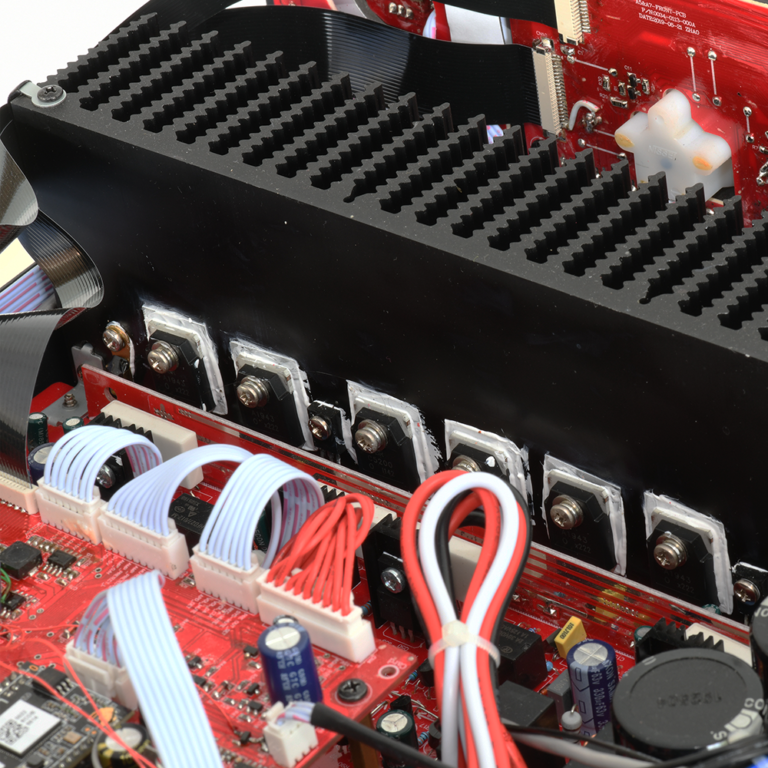
Advance Paris has two versions of the Playstream, the A5 and A7. The A5 is specified at 80 watts per channel into 8 Ohms and the A7 is specified at 115 watts into 8 Ohms. Both are Class A/B, while the chassis size and the inputs and outputs are identical. While I did not pop the lid I could see through the air vents on the top of the chassis that it has a toroidal transformer and appears to be well built.
The less expensive and a bit less powerful Playstream A5 is a monster for the money. I have never seen a 2-channel amplifier at this level with so much versatility. The back panel is festooned with options, but lets start with the front panel.
Front Panel
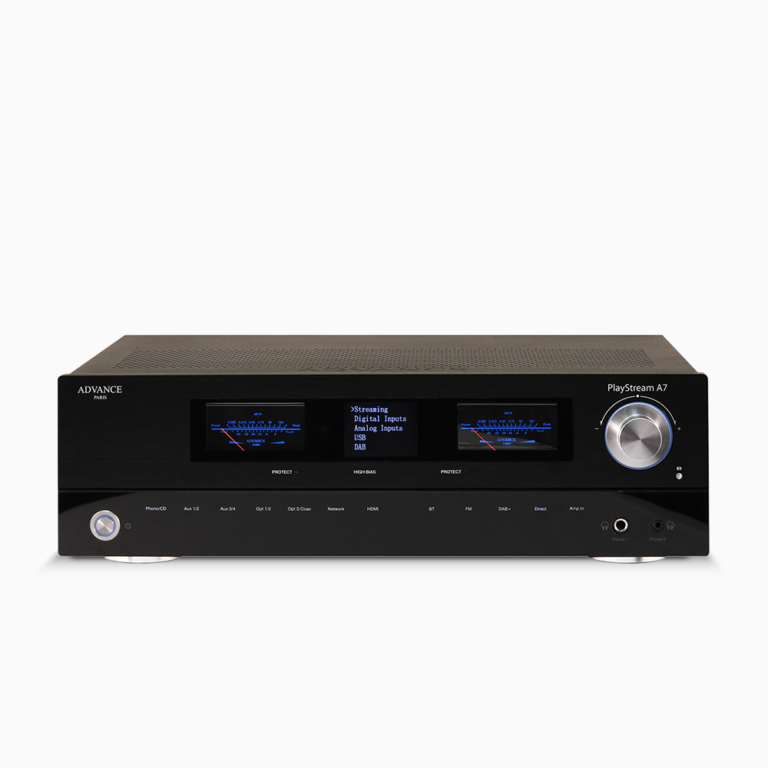
The stunning inclusion of dual VU meters that cast a blue shade over the room is the central feature of the front panel. Besides this there is a stand-by button on the left, and one central silver knob located on the right side. The silver knob is for the selection of all the menus and sub-menus that govern the operation of the amplifier as well as defaulting as the volume control. Below this volume control are found no less than two headphone outputs.
A central square located between the VU meters is reserved for digital information that reflects where you are located within the menu hierarchy, as well as providing a reading (in relative dB’s) on the volume level. A line of blue LEDs finishes the front panel as the available submenus for the inputs can also be selected by pushing gently on these LEDs rather than using the single rotary control.
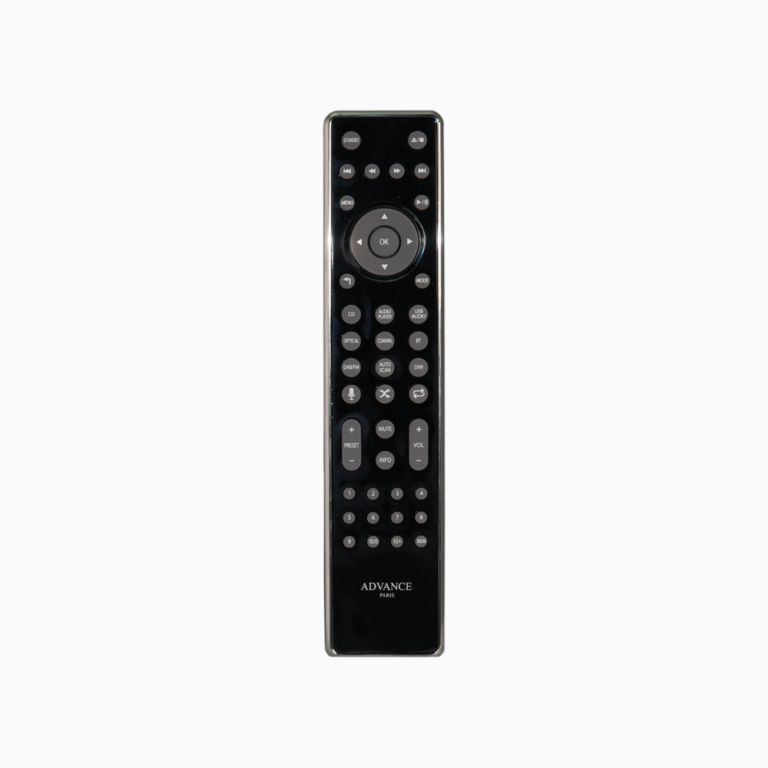
And of course there is a stylish remote included that mirrors the functions attained with the rotary knob, while providing a few extra conveniences. So there are many ways to access the playback functions, including while sitting in your listening chair.
Back Panel
In the hi-end business we are used to amplifiers with ‘minimalist’ trimmings these past decades, and the Playstream A5 – while retaining a clean appearance – is the complete opposite. This is a device where the user is going to want to study the user’s guide. There is a lot going on here.
The master on-off switch is located on the right side of the back next to the AC voltage input socket and the unit is switchable between voltage supplies.
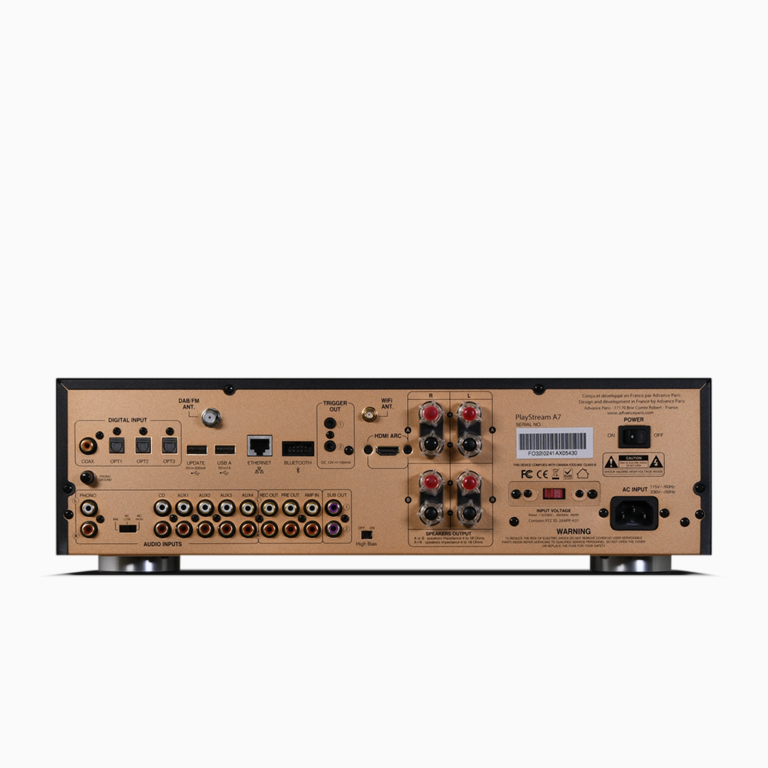
Beginning on the extreme left side the A5 first sports a phono stage input that is switchable between MM and MC inputs, as well as having two levels of gain for high and low output moving coils. A ground terminal is included.
Next up are five RCA line level analog inputs, as well as pre-amp out and sub-out sockets, and an amp-in set of sockets. The A5 is therefore alll set up to do duty as a streaming pre-amp, should the buyer so choose. Above these sockets is the junction for the Wi-Fi antennae.
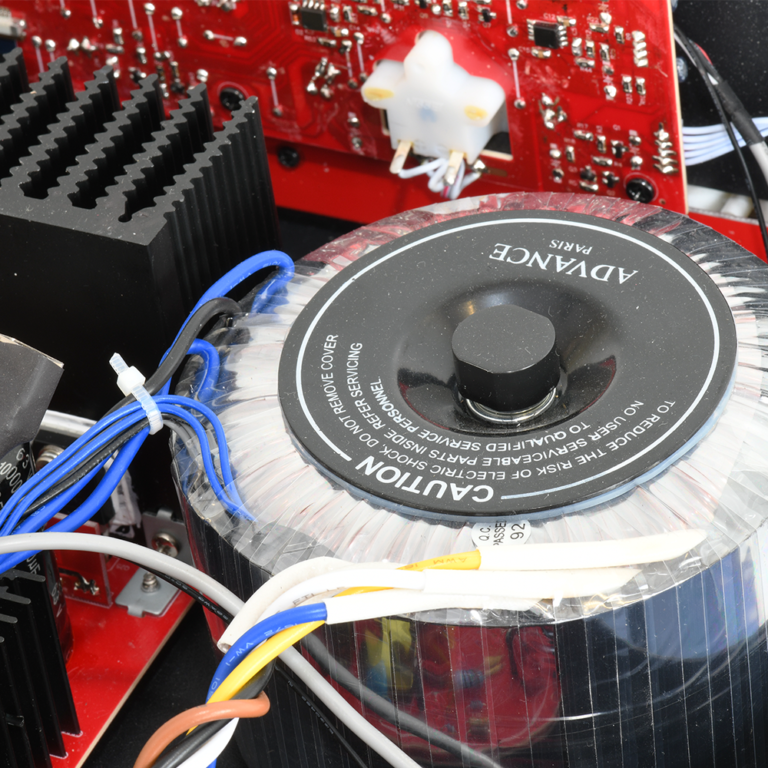
Also found above the RCA input sockets are an array of digital ins and outs. Digital coax has an input and there are three optical ins and an optical output. A USB Type A input is clustered beside the other digital ins and outs and a second USB input is reserved for technical maintenance. An ethernet port is included here as well as another antennae junction for the FM tuner found near the top of the panel. A simple dipole antennae is provided for in the packing box.
Nestled between the digital and analog ins and outs and the AC input are the speaker outputs. These are well engineered multi-way binding posts and I used banana plug cables for all my listening.
Finally, there is a special input block reserved for a Bluetooth antenna. A Bluetooth accessory is included in the box which will handle AAC and aptX codecs, but Advance Paris also offers a premium Bluetooth accessory that will decode aptX HD if you have a phone or other device that will handle that. (Footnote)
The back panel is thus quite complicated but also quite complete as far as streaming is concerned.
I should also mention here that the A5 uses a Burr Brown (Texas Instruments) PCM1796 DAC. This DAC has been around in one form or another for a long time and it was certainly a wise choice by Advance Paris, since it has to handle all the main digital streaming duties. I am normally used to Wolfson DACs, but I found the Burr Brown to be eminently listenable and it really swings.
Wi-Fi and Networking
I got the Wi-Fi working and then got Tidal functioning after a certain amount of trial and error. Unfortunately the included user’s guide is somewhat obscure on the topic of networking. I had to more or less figure it out by myself and it was a real challenge. I also had to move a network ‘repeater’ into the living room to get a strong enough signal to pair my Samsung phone with the A5 component.
But the upshot is that my Tidal playlists were available to me as I was typing this review and the Burr Brown DAC was doing a wonderful job with them.
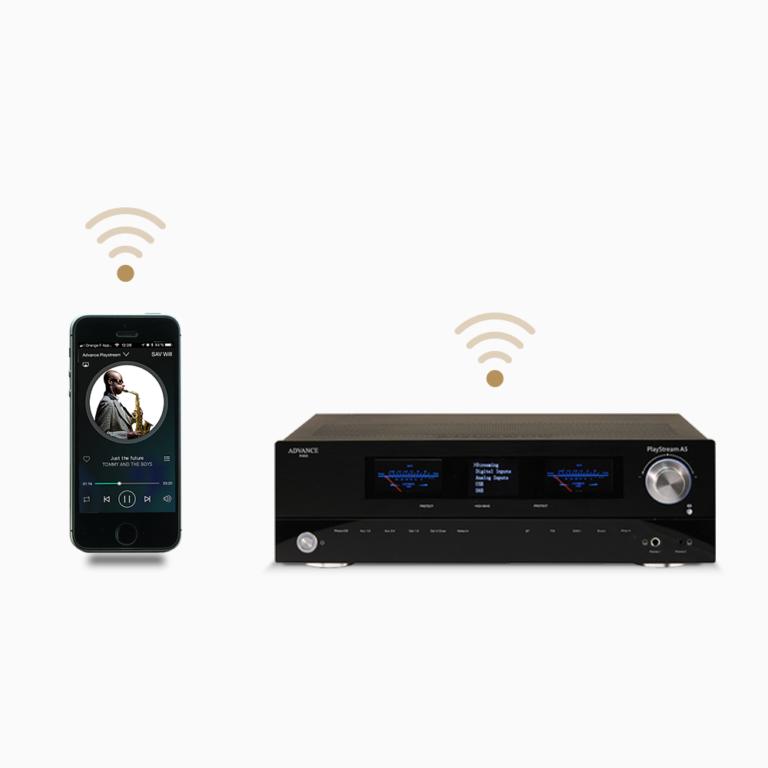
All A5 streaming users will have to download the Playstream app on to their phone, and it is only fair to comment on this facility. I would rate the app as average. It covers the important bases and offers many options, but when compared to something like Bluesound’s BluOS app, there is a certain clunkyness to it.
However, it pairs nicely wih Tidal and all my Tidal playlists were available for immediate use. I found that over the three weeks I had the component I used the Wi-Fi connection and the Burr Brown coax input for the majority of my listening time.
Hi Bias Selector
The Playstream A5 offers a unique way to upgrade the sound. On the back panel is a switch that allows the owner to initiate a Hi-Bias function. Even though this is a Class A/B amplifier, by selecting the Hi-Bias function the amp will operate in Class A mode for the first watt of its output. Another blue LED on the front panel lights up when this function is selected. I took advantage of this function and used it throughout the test period as I felt it improved the soundscape.
Ranking the Inputs
Rather than walk the reader through a long discussion of the specific tracks I played over a period of three weeks on the A5 I have decided on a different tack. I am going to rank the various inputs offered by the A5 by their musicality. I feel I can do this because of the exceptional resolution of the JMR Bliss Silver speakers.
The rankings found below are notional and not absolute. They have to be taken with some salt. Higher up the scale means ‘likely better’ and not ‘absolutely better’. Similarly, lower on the scale means a bit worse but still pretty good. The only outlier is the Bluetooth entry which is listed last and this requires some special treatment and commentary as the reader will see.
# 1 Line level. The line level analog inputs on the A5 in particular (and there are five of them) are very, very good indeed. I was struck right away by the clarity of this amplifier through the line level inputs.
In testing these inputs I ran both a CD Player through them as well as an external phono stage (with moving coil input) via the analog 1 and 2 inputs. After much comparison with the other inputs I decided that the five analog inputs held their rank at first place.
# 2 Wi-fi. The DAC in the Playstream is critical to the performance of the digital ins and outs for both S/PDIF and Coax. Fortunately this DAC is also very good and holds its own against the dual Wolfson DACs in my Cambridge Audio CD player.
I checked the Coax and Optical inputs by running Coax and Optical out cables between the CD player and the inputs on the A5. What emerged from the speakers was a very smooth and eminently musical output that had me toe tapping almost immediately.
The people at Advance Paris have chosen this DAC well, and all the digital inputs and outs on the Playstream benefit from this selection. I ranked the Wi-Fi and digital ins and outs in second place.
# 3 USB. While the USB input ultimately depends on the quality of the DAC there is also the matter of USB implementation to consider so I checked this out separately. I downloaded a series of FLAC files, in this case selections from Eva Cassidy, on to a thumb drive and transferred the drive over to the Playstream A5.
By selecting the USB input the files were quickly revealed and played easily. I could not detect any real difference in the quality of the reproduction between the Wi-Fi, the Coax and Optical inputs and the USB implementation so while it ranks third, the USB input really ties-in with the above comments for second place.
# 4 Phono Circuit. The MM/MC input is the only real weakness I found. I suspect it is all about economizing as this is a budget unit. But I must report that the Op-amp circuit selected is just adequate. All the design money has likely gone into the digital boards since that is most suited to modern use, e.g. streaming. Analog vinyl input has taken a back seat here.
It is not really that the MM/MC input is bad, but it is just OK under the circumstances. When I compared it to the analog input from a stand alone budget level phono pre-amplifier such as the Parasound Zphono, the MM/MC circuit on the Playstream really started to show its limitations.
I imagine though that many buyers will be looking at this amplifier not for its MM/MC circuit but for the Wi-Fi streaming circuits onboard and so this weakness is really going to be a moot point in those cases. The extra analog inputs just beg for a phono upgrade path, and many inexpensive MM/MC circuits are available as stand alone phono preamplifiers. I suggest that vinyl enthusiasts look carefully at these options.
# 5 FM. The fact that it incorporates DAB+ and FM tuners punts this ‘amplifier’ into receiver territory and I am not sure how to handle that aspect. An accessory antenna is included in the package so that is quite nice.
FM usage is a snap. Just attach the antenna, select FM on the remote and then punch autoscan and the FM circuit will scan the airwaves and assign a series of presets (up to 40) for the stations it finds. Now for sure this FM tuner is not a Magnum Dynalab unit and so it has limitations. In Stratford where FM reception is a bit dodgy I was able to log 10 solid stations that were listenable.
A better antenna, including an outdoor type, would likely double or triple that number, perhaps more. Sound quality, in today’s FM space, is highly dependent on the amount of compression applied by the station in order to stand out from the crowd. I find this compression very annoying and avoid FM except for CBC public broadcast on a table radio. Thus I have to rank the FM circuit lower than some of the other inputs. However for casual listening it is certainly sufficient.
# 6 Bluetooth. I had not planned on checking out the Bluetooth setup as I only have AAC on my phone which is a pretty primitive codec. Despite having only AAC available to me there are, however, other hi-fidelity solutions. Advance Paris makes aptX available on the standard adapter and aptX HD is available on a much better upgradeable Bluetooth adapter (Footnote).
Bluetooth setup, like FM implementation is a snap. Just insert the Bluetooth adapter into its slot, select Bluetooth, and pair the devices. Then go into your favourite streaming service app, and press play and music enters the room. But as I say, if you want real Hi-Fi you will have to get aptX or aptX HD on your phone. The AAC codec I have on my Samsung phone unfortunately insists that I rank the Bluetooth input as last . Availability of either aptX or aptX HD would likely vault it to the number three or four position.
Conclusion
To repeat the byline offered at the beginning of the review, this is a Swiss Army Knife of an amplifier. For the money involved it is a fully featured streaming device with an excellent sound signature. It is well built, it looks classy and the blue VU meters on the front are a splashy and hypnotic addition.
Despite its weaker MM/MC phono input performance, I can firmly recommend it to readers of ‘Wall of Sound’. In conclusion, I look forward to reviewing other components from Advance Paris, as news of their products steadily grows in North America.
Footnote: This upgrade device (the X-FTB02 Bluetooth receiver) is about $200. aptX HD is a Bluetooth audio codec developed by Qualcomm that delivers high-definition audio streaming, supporting 24-bit/48 kHz audio at a bitrate of 576 kbps. Whle this is not lossless, it is close. Previous WoS articles have addressed these codecs and their subjective performance.

Disclosure: Wall Of Sound Editor Noam Bronstein is an Advance Paris dealer. This review was done independently of his input.